Pages


Thursday, June 10, 2010

Almost done with shearing!


Sometimes I just have to stop and marvel at the beauty in nature.  This morning it was a spider web in a pine tree that was beaded with tiny drops of water.  Kind of reminded me of my now finished beaded shawl  .


Monday it was a gorgeous moth on a chair in the yard.

We still have a few alpacas to shear, 3 adults and 3 crias, although one of those 3 crias has yet to make its appearance.  My older girl, Peg, is at 366 days gestation today.  I'm getting anxious!  

Unfortunately, I have not been able to get the shearing photos I'd like to have since I am always busy during shearing, but I do have some and can explain what we do.

Sheep shearers are fascinating to watch.  They grab a sheep and bsically sit it up on it's butt with it's back up against their body and proceed to clip away, either with electric or hand shears.  The sheep for the most part submits to this without too much fuss.  They ARE sheep after all.

Alpacas on the other hand will definitely not sit still for that kind of treatment.  In general, they do not like to be confined, grabbed, handled or even petted.  Therefore, shearing, which requires all of the above is not their idea of fun.  Alpacas have long legs and can pack a nice kick.  Each foot is tipped with 2 raptor-like toenails, capable of shredding a T-shirt and scratching skin (ask Sam, he knows).  So in the US we have devised ways to restrain alpacas for shearing which is safe for both the alpaca, the shearer and anyone else who might be in the barn.  We even attempt to contain the spit which inevitably flies when an alpaca gets mad enough.  "Mad enough to spit" takes on a whole new meaning!


In order to make our fleeces as nice as possible and to cut down on the wear on our shear combs and cutters, we try to get as much dust and debris off each animal prior to shearing.  Yes, my Kirby vacuum cleaner lives in the barn during shearing season, so don't expect to come over and find my carpets clean!  Each alpaca is brought into a catch pen and vacuumed as thoroughly as possible.  Do they like this?  No, not really and some protest vehemently.  This is where kicking is likely to happen.  
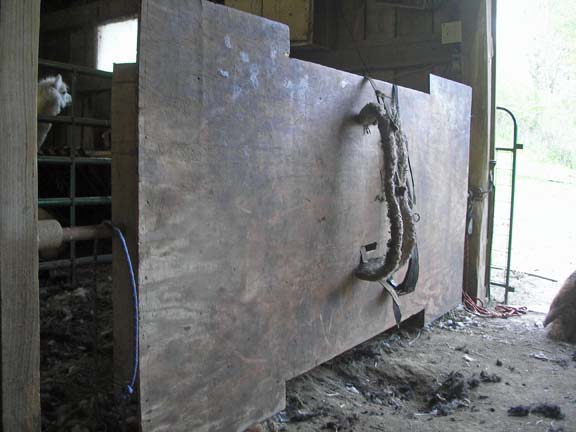
 

Once cleaned up, the alpaca is lead to our homemade shearing table, which tilts to vertical.  There are 2 straps on the table which are fastened around the alpaca's belly, and then we tilt the table so it is horizontal and the alpaca is laying on its side.  Now we need to restrain those legs, and we have a set of ropes for the front legs and one for the back legs which are attached to a ratchet device, allowing us to stretch the alpaca out on the table.  This does not hurt them, it merely annoys them!

Once on the table, Sam goes to work with the shears while I hold the head to control the animal.  Hopefully we have friends present to help with gathering up the fleece as it comes off the animal.  We can get up to 10 pounds off each animal, with 6 being average.  Here are 2 views of the same alpaca on the table being shorn.  The fiber (as the fleece is called) is separated into 2 bags , prime (or the best part) and seconds.  Anything unusable goes on the floor and is raked out the door for the birds to use.


While the alpacas are mostly immobilized on the table, we try to take care of other unpleasant chores, such as toenail trimming.

This is also a good time to vaccinate and check teeth.  We need to trim teeth from time to time on some animals and males have sharp fighting teeth that need to be cut off or they are known to use them to emasculate their rivals/pasturmates!

Most alpacas take this process with little complaint, but some scream through the whole thing as if they were being flayed alive.  Some urinate all over the table, others spit.  Occasionally we get a truly prolific spitter which requires that one of Sam's old socks be put to useWe had one such girl this year who literally filled a tube sock with foul green spit.  This stuff could be used in chemical warfare. It is stinky and nasty.  Basically, the alpaca regurgitates partially digested grass and can project this concoction an amazing 6 feet.  The photo to the right is Elli, and while she did not require a sock, you can see her green lips and the green stuff that has dribbled out of her mouth as we were working on her.  

From the time we bring an alpaca into the catch pen until we turn her loose back in the pasture, having experienced a full spa treatment, it is about 20 minutes.  Sam and I are so thankful to have friends who don't mind getting dirty and come over to help us with this chore.  We usually have a lot of fun and food and drink follows the job.  

As mentioned earlier in this post, I finished my mystery shawl this week!  Yeah!  The edging took me almost a month, but it required knitting on 2800 tiny beads! I am very pleased with the result.  I think it came out beautiful.  Next project?  I have a summer top I am working on in a hemp blend and some socks and  and and........

Thursday, June 3, 2010

Summertime!

June is here and that means summertime.  Hot humid days fading into cool nights.  Lots of work to do on the farm.  We love to see healthy, active crias romping in the pasture!


We are still not done shearing.  Almost there, but things have been so busy that there are not enough hours in the day.


I took 2 female alpacas to northern Ohio last Thursday for breeding and on the way home my brake line broke on my truck, so it was out of commission and 70 miles away for a week.  Got it back last night and now I still have one alpaca to deliver to PA for breeding.  No one was injured in the incident and I was close by some good friends who helped me out big time.  It reinforces how important good people are in our lives.  Thanks, Bill & David.
 
Friday evening, Elli delivered her cria, a super cute little male.  Here he is: 


I attended the Great Lakes Fiber Show in Wooster Ohio on Saturday with a friend and dropped off about 65 pounds of fiber to Morningstar Fiber Mill  http://www.morningstarfiber.com/    to be made into rug yarn and knitting yarn.  I hope to be able to start weaving alpaca rugs by the end of August.  The knitting yarn will be dyed and sold and I will probably use some myself.  In addition to dropping off fiber I chatted with friends and did a little shopping.

Sunday we needed to bale and put in the hay that Sam had mowed Friday and Saturday.  We got about 50 bales off a small field and about 100 off our new field.  We could have had another 100 or so, but didn't need that much, so we called a neighbor and told them if they came and baled it, it was theirs.  They do round bales for their cattle.  Our first cutting hay is for our horse, Apache, and 150 bales should easily get him through the winter.  We feed second cutting to the alpacas. We will do that hay in August.  The photo above is Sam raking the hay prior to baling.


Here is the small field along the road with the bales ready to be picked up and put into the loft.  We had to borrow the neighbor's truck to pick up the bales since ours was in the shop.  We have great neighbors!


My mother also arrived for a visit on Sunday in the midst of all the work.  We had been dog-sitting for her and she was coming to take her dog home and spend a couple days with us.

 
On Monday evening, Sidney, one of my boarder's alpacas, delivered her first cria at about 5 pm. She had a healthy black female cria.  This was the second birth my mom was here to witness.  It's aways exciting.  This cria was the first cria from our black herdsire (stud), Oscuro, so it was doubly nice that it was a female and black.
 

Tuesday evening, I had my first lesson in running a chainsaw.  I have never really wanted to use one before, but we will need a lot of wood cut up for our syrup evaporator come February, so it will be good for me to help out.  Plus, we wanted to clear out some more pine trees from one of our pastures, so Sam can cut them down and now I can cut them up.  Notice in the photo I am wearing protective chaps (that sentence was for my mother's benefit!).


This morning, another of my boarder's alpacas, Ahnnie, delivered a little male cria while I was doing my chores before work.  This was the 5th of 6 crias due this spring, so only one left to go.  My girl Peg is holding out on me at 359 days of gestation today.  I think our farm record for long gestation is 373 days, so hopefully she won't be going for the record!  I am ready to have them all delivered.  Here is Ahnnie and her new baby.


Sam is cutting down trees to run through the sawmill for lumber for the picnic shelter he is building up by the pond.  He is going to make it 24 X 24 and will be building the roof trusses himself.  He was hauling out a 14' poplar log as I was leaving for the office this morning.  


I am almost done with my mystery shawl.  The edging is taking  long time, but time to knit has been in short supply lately.  I have a goal, though, of having it done by my next spinning guild meeting which is a week from today.  I should make it.  We'll see!


Thursday, May 20, 2010

May has been busy!

Life may be busy, but sometimes you just have to stop and smell the flowers, right Rowdy?!

We had a nice visit from our older son, Ian, and his girlfriend, Michelle, the first week of May. They live in California at a lodge just outside Yosemite National Park. They both work at the lodge, as does our younger son, Sam. We don't get to see them very often, so it was a great time and the weather was about perfect! Michelle had never been here, but she has lived in Alaska and Oregon and California, so I am sure Ohio was a bit tame.

We have finally been able to start shearing our alpaca herd. The cool rainy weather we have been experiencing here has got us a bit behind schedule, but we'll get it done eventually. Hopefully for my next blog post I will have photos and can do a shearing tutorial for those who may be interested in what shearing alpacas entails.


Meanwhile, we have had one more cria born, a little black female, belonging to one of our boarders. Both she and the little boy from the last post are doing well. We still expect 4 more.

The garden is coming along. We have been having salads as I thin the lettuce and spinach. Beets, peas, onions, and squash are all coming up and I have planted some pepper and tomato pla
nts. The asparagus bed is doing well, although we had a couple of late frosts and some stalks were killed off. I think by next year we should be able to enjoy the fruits (or veggies) of that labor!

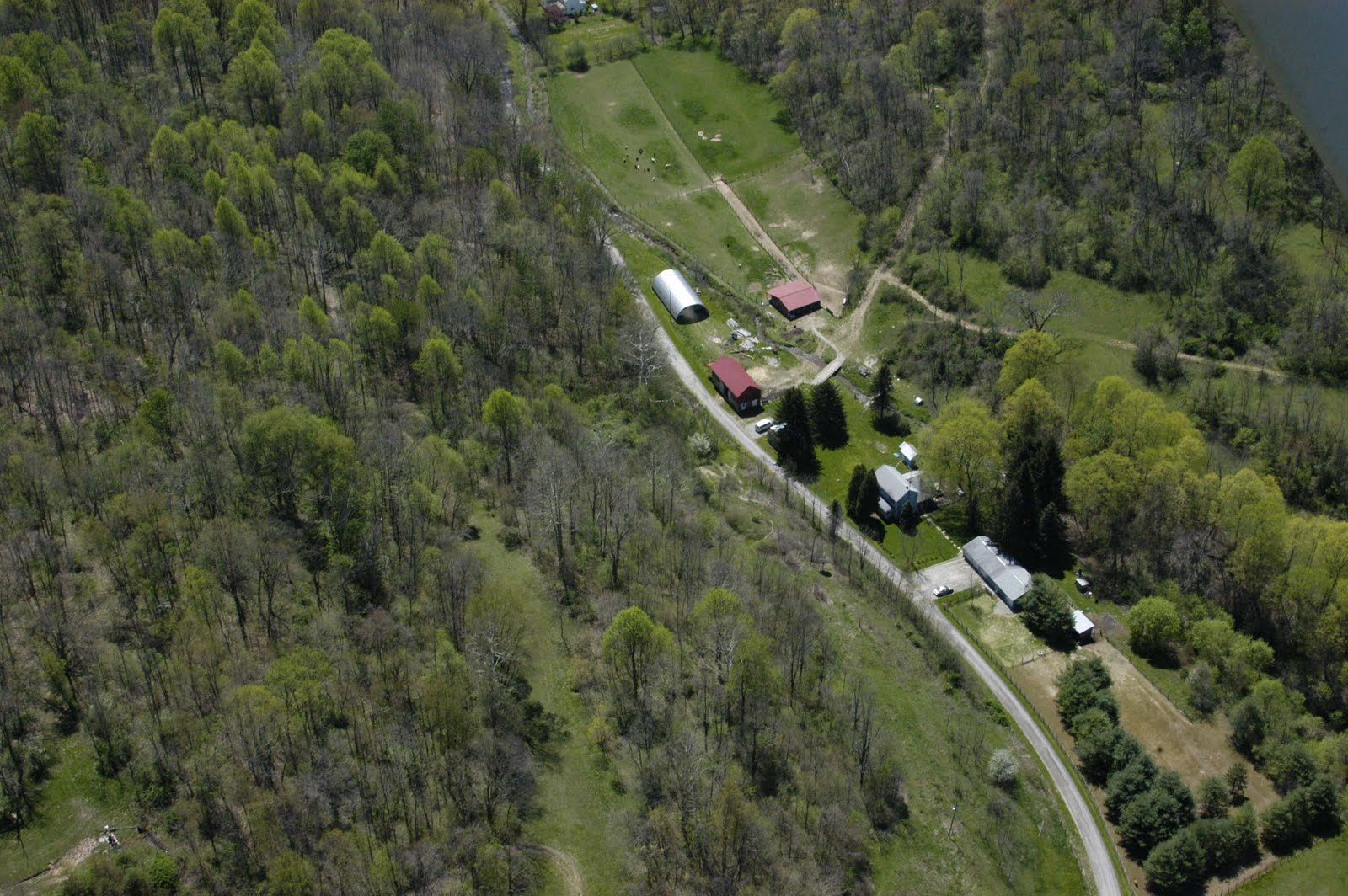
Since I don't yet have shearing photos to write about, I thought I'd post some aerial farm photos we had taken a few years back and describe our farm layout. We are located in the foothills of the Appalachians, so there is very little flat land in our area and our farm is no exception. Our house and buildings are located in a "holler" or "creek bottom" and so to get just about anywhere, we must go uphill. It can be a challenge in winter, so we do have a couple of 4 WD vehicles.

This first photo is of the main house and buildings. From the upper part of the photo is the poly shelter, which houses the tractor, mowers, trailers and other large equipment. To the right of that (across the creek) is the "Girl's Barn" where our female alpacas live. Cheetah lives here with them. You can see the runway to the back pastures and you may be able to see the alpacas themselves if the photo is large enough on your screen. The red-roofed building below the poly-shelter is call the horse barn. This is where my old horse lives. He has a huge run-in stall and is not ever shut in. We also have hay lofts in this building and here is where our hay is kept. Just below this barn, partially hidden by the huge pine trees are an old corn crib (soon to be chicken house) and storage building. Then there is our house and small summer kitchen and then the garage/workshop. There is another alpaca field just below the garage which has a small 3 -sided shed in it. If you look in the lower left hand corner of this photo, you can see one of the gas/oil wells on our property, which is way up above the house.


In the photo to the left, I have tried to outline our property in white. You can see our main house and buildings top center, then the neighbor's house and at the bottom is our guest house and 2 more alpaca fields, each with a 3 -sided shed, one across the road from the house and one behind the house. There is also an older barn at the very bottom of the photo.


This final photo is a larger view of the whole neighborhood. It may be a little easier to get some of the scope of the hills an woods from this one.

I am still working on my mystery shawl, but am onto the beaded border, so it won't be long now. I will post a photo of the finished shawl when it is done.

I really need to concentrate on skirting some fleeces now. In a little over a week I will be attending the Great Lakes Fiber Festival in Wooster Ohio and hope to drop off about 60 pounds of fiber to be made into rug yarn. Then it will be time to get my loom going and make some awesome rugs!

Wednesday, May 5, 2010

Cria Birth, Graphic Photos

Our first cria of the year arrived Friday, April 30. It was a beautiful, sunny spring day, perfect for a new arrival. As promised, I took some photos and will describe the birth of a baby alpaca.

The mother alpaca, or dam, is Miracle. You may remember she is the cria I found Cheetah guarding in the barn almost 3 years ago,
who almost died and spent some time at Ohio State's vet hospital. Well, we have now come full circle and Miracle is mother to her first baby and it was a perfect birthing.

The first signs of impending birth are often very subtle, but I have come to be pretty familiar with them. The expectant mother may roll frequently, or get up and down and act agitated. She may stand at the poop pile for extended periods of time without actually going. She may hum continuously, she may not come in for her morning feed. Each one is different and may exhibit any or all of these signs. Here, Miracle is standing at the poop pile. Her tail is wrapped to keep the hair out of the way so I can see what is going on easier.

Miracle's labor was fairly quiet and slow. When she got close to Stage 2
of labor, which is actually pushing the cria out, she became very much more agitated and got up and down constantly, humming all the time. I keep a close eye for contractions, because once I see her actually pushing, I want to see a sign that baby is coming out very soon. And what I want to see is nose and toes. The cria should present like it is diving into a pool, with its front legs first and its head and neck stretched out along the legs. I generally breathe a sigh of relief when I see a nose and 2 feet because not much can go wrong once those come out.

Soon, the head and the legs up to the knees come along, and often the dam takes a little rest at this point to prepare for passing the shoulders, which are the biggest part of the cria. Now the cria usually starts to shake its little head and snort attempting to clear its nasal passages of fluids and of course it starts to breathe on its own. Often, this surprises new dams and if they are on their feet, they may spin in circles to try to see what that is making that noise on their backside. Miracle, however was laying down and tired.

This is a point where I can help if the dam is tired or the cria is large and I did help Miracle a little. As she strains with contractions, I can gently pull on the legs to help her hasten things along. It is a slippery job.

Once the shoulders are out, the rest follows along quite easily. And this is when we can check to see if we have a girl or a boy. It's a BOY!

You may notice the cria looks shiny. They are born with a shiny membrane that covers their entire body and which I start to peel off as soon as baby is born. I also check to make sure the cria is not bleeding from the unbilical cord stump, which I then dip in iodine to prevent bacterial infection. I dip the cord 3 times in the first 24 hours. Otherwise, at this point, we just let mama take over. Here I have placed the new cria in front of Miracle so she can sniff him and hum to him and start to bond with him.
This is very important because if she does not accept him as hers, she will refuse to nurse him and I will be stuck with a bottle baby for the next several months, which may seem fun at first, but gets old quickly. We have had dozens of births here over the last 10 years and I am always amazed at the natural instinct the mothers have to mother their crias. And the crias are amazing in that they have such a strong instinct to FIND THE FOOD SOURCE! It can be comical watching them stagger in circles around the dam with their little tongues sticking out in the sucking mode trying to find the udder. Sometimes I give them a little help and point them in the right general direction.

Since it was such a nice day and it was now after 3 pm, I took Miracle's cria out into the sunshine to dry off and have some more bonding time with mom. Mother alpacas do not lick their crias dry as most other mammals do, so I love it when crias are born on nice warm sunny days. If it is cold and damp, I use a hair dryer to get the cria as dry as possible and then put a coat on it. As you can see in this photo, he is less than an hour old and already attempting to stand up.

The 3rd stage of labor is the passing of the placenta, which usually happens within a couple of hours after the cria's birth.

So, from 9 am, when I noticed signs of labor, it was 6 hours until the cria was born and he was up nursing and running within 2 hours. Most likely, Miracle's next labor will be much shorter. Sometimes, I miss the whole thing if I run to the house for towels or the camera, which is fine with me because that means all has gone well!


Thursday, April 29, 2010

Spring is a Busy Time!


Everything is so green! The photo above is one of the paths that we hike/run on through the woods on our farm. It really IS that color this time of year. Just incredible. Soon, though, summer will be here with its heat and the tender spring foliage will dry out. But that just brings other beauty to the woods.

I finished up my Spin-Off entries. I judged 71 black,
grey and brown entries. The photo here is of my work area while I am judging: I have lettered the items and will explain the use of each. A (Zip-Loc bag in center left): is the actual entry as I receive it. It is a minimum of 2 oz.
B: white poster board onto which I spread out the entered fiber to judge. Anything that comes out of that baggie goes back in. You can see some dirt and little bits of fiber, which are called second cuts. That will all go back into the entry bag (and hopefully not on my floor).
C: Scorecard where I give or take away points and make comments.

D: Hand carders which are used to prepare the fiber for spinning
E: Rolag (brown curved object far right): this is what the fiber looks like once I have carded it and it is ready to spin.
F: Ball winder: Once I have spun the rolags, I need to make a 2-ply yarn, so I wind a center-pull ball which has an end coming from the center and one from the outside. I take both ends and twist them together into a 2-ply yarn on the spinning wheel.
G: Spun samples in skeins ready to be washed.
H: water-proof tags with entry numbers on them to identify each skein for washing.


This is a messy process and I get fiber everywhere. It is also very du
sty. Times like this I wish I had a basement so I could have a permanent work area set up. But I just make do.

Last spring we put in an asparagus bed and it has been exciting to s
ee the new stalks coming up. Hard not to pick and eat them, but we have to let it get established. Unfortunately, we have had frost the last 2 nights and have covered the beds as best we can, but some taller stalks have succumbed to the frost. In all, though, I think it will be fine.

Sam has also put in 14 more hop plants. Last year he put in 2 and ended up with about 2 oz of dried hops to put in his beer. Here are the ones he planted last year.
They are a climbing plant and like sunny locations. I'll post the new ones once they look like something. Might take a while.

Haven't done much more in the garden. It's getting to be time, though. Hopefully this was our last real cold snap.

Our first crias are expected any day now. It could be another 3 weeks or more though. Alpacas are not very exact in gestational times. They can go from 11 months to over a year. It is a watching and waiting game. I hope to be able to photograph a birth this spring to post on this blog. Timing will be everything. It does help that most births occur between 9 am and 3 pm. This is an adaptation that New World Camelids made to living in a high mountainous environment. If their young are born at night, they are liable to freeze to death, so they birth early in the day so the baby has time to dry before the cold nights set in.

We haven't started shearing yet. I'm glad. It was too cold the last couple of nights. But we need to get on it!

I'm still working on my mystery shawl. I'm now on clue 6 of 7. The last clue will be adding beads. It will be time-consuming and interesting. Here is a photo of part of the shawl up through clue 5:


Thursday, April 15, 2010

Meet Cheetah!


Meet Cheetah, our livestock guard dog, or LGD. Cheetah is a Great Pyreness, a breed of dog which has been specifically bred to guard livestock. A lot of times when we think of a guard dog, we think of a somewhat aggressive breed like a Rotweiller or Doberman Pinscher. Or when we think of a livestock dog, we think of a herding dog, such as a Border Collie or Australian Shepherd. However, the Great Pyrenees (or Pyr) and several other breeds of dogs have been selectively bred to bond with their livestock charges and stay with them and protect them from predators.

All dogs are basically predators, having been domesticated from wild ancestors. They are all
hunters at heart. Herding dogs have a strong "prey drive", which, along with directions from the shepherd, they use to move flocks of sheep. If you have never seen a Border Collie working sheep, you are missing something! They crouch and give the sheep the Border Collie "eye", which I am sure is very intimidating to the sheep, which are prey animals. LGDs have had the prey drive bred out of them. They have no desire to chase and hunt. They are very protective of their flock or herd. They move with the herd as it grazes and are always vigilant for predators.

Cheetah is 120 pounds. His greatest wish is to be a lap dog in his next life. He loves people. He has never been in a house. He lives with the alpaca herd in the barn. He sleeps most of the day and patrols at night, barking and making his presence known. In my opinion, any coyotes in the area are smart enough to know that there is plenty for them to eat without coming near that large bark!

We have had Cheetah since he was abo
ut a year old. He will be 6 this fall. He has not always been an only LGD. We had one Pyr when we got Cheetah. His name was Dash and he was 140 pounds. He was a big sweet guy, but he died 3 years ago of a twisted stomach (if you've read Marley and Me, Marley suffered from the same condition), which was rough on Cheetah. They were great friends. We then got another puppy, who took to digging under our fences at about a year old and got out one day and met with an unfortunate end at only 13 months old.

Here is an example of a livestock guard dog doing his job. Almost 3 years ago, I was away fo
r the day in August. We had no alpaca babies due for at least another month, so I was not concerned at all. When I came home and went out to do the feeding in the evening, all the alpacas were in the back field grazing. When I went into the barn, I realized Cheetah was in the barn and there was something laying next to him on the floor. It was a cria, or newborn baby alpaca. It was a month premature and it was its mother's first cria and she had evidently delivered it and then gone out with the rest of the herd. The cria was still alive and Cheetah was guarding it. We found the mother and put her in with the cria and since the cria was so early, I spent most of the night milking the mother and feeding the cria with a dropper. She was trying very hard to make it, but by morning was not doing well, so I loaded up mom and baby and took them to Ohio State University's vet hospital, where they stayed for 2 weeks. The cria managed to pull through, although the vet's said she should have died. "Miracle" is now almost 3 and due to have her first cria in May.

We have had many school groups come t
o our farm, from pre-schoolers, to 8th graders and Cheetah is always a hit. The pre-schoolers are eye to eye with him and I have yet to have one be afraid of him. He is truly a gentle giant.

Did I mention he loves to give kisses?


Spring is in full swing. The redbuds are in bloom and the wild apple trees have blossoms on them. The woods are beautiful this time of year. The trees have a faint haze of color as the leaves prepare to open up. There are tiny wild flowers everywhere I look. The days are warm and the nights are cool.

I am still working on the Spin-off and also knitting on my mystery shawl. I am on clue 5. Clue 6 comes out in 8 days. There are 7 clues, so we are getting to the end. The last clue will be the big one, I think, since we will be adding beads!

It is about time to seriously think about shearing. Watch for that soon!

Thursday, April 8, 2010

Playing Possum Really Does Work!

Yes, another sign of spring is that the critters start moving around. Rowdy has caught possums in the yard 4 times, at least 2 different possums and 2 in the same day! As you can see from the photo, they curl up in a little ball and don't move. When Rowdy pokes them with his nose and they don't squeak, he loses interest and leaves them alone. I have even picked them up by the tail without them moving. They also "grin" and show all their teeth, which are impressive, but do not offer to bite. About 1/2 an hour after I took this photo, this guy got up and continued on with his business.

One of my favorite jokes of all time:

"Why did the chicken cross the road?"
"To show the possum it could be done!"

I know, it's stupid, but I love it.

This past week or 2 has been busy. Once again all the alpacas needed their wormer shots, so I did that. Saturday morning, I separated the rest of the fall crias from their mamas and moved them all to a new pasture where they are adjusting well. 2 of them are leaving for their new home in Georgia this weekend, so they need to go to the vet for health papers tomorrow. Hope I can catch them!

I have also been busy with spinning. I am judging a "Hand-Crafter's Spin-off" for the Alpaca Owners and Breeder's Assoc National show and conference. I have done this several times. Basically, breeders send in a 2 oz sample of their alpaca's fleece and they are put into classes of same color and age and sent to me and a couple other judges. We judge each sample on several criteria, spin up a portion of the fiber and score each sample. A class may have 3 entries or 15. The possible total points is 100. It is interesting because I get to spin some very nice fleeces and also some poor fleeces. I think it is educational for breeders who are not fiber-savvy. What is really hard sometimes is trying to be positive about a terrible sample. I remember once I got one that smelled so bad I hated to touch it, but the rule book says I can't DQ a sample for that, so I had to judge it. I can only DQ if the sample is insect infested (haven't had one of those yet, thankfully) or too short to spin. I have had those. I do get paid for this, but not really enough for the time that is involved. But it does help finance my fiber passion (should pay for that spinning wheel I just bought!).

I have also been doing some work outside. The garden is tilled and I have planted lettuce, spinach and beets. We have tomatoes, peas, peppers, and basil started in little pots to put out soon. Also have some onion sets to put out. Sam says our asparagus, which we put in last year is coming up, yipee! Hopefully we will get to eat some this year. We'll see. Can't wait for a fresh baby lettuce salad! Yum.

I'm still plugging away on my mystery shawl knit-along. Tomorrow the 5th clue comes out and I have 2 rows to knit on clue. It was 24 rows of 560 stitches, so time consuming and with the nice weather it is hard to justify sitting and knitting!

Next week I hope to start introducing some of the other animals on the farm, but I need to get current photos of them. Watch for Cheetah, the livestock guard dog soon!